Home / Platforms / Misroute & Compliance Detection
Misroute &
Compliance Detection
Ore in the waste dump is value you already paid to drill, blast, load, and haul. It
does not show up as a variance, it shows up as grade that never arrived, weeks later,
with no way to tell which loads did it. This checks every completed dump against what
your block model and your destination configuration actually say, and puts it in front
of someone who can still act on it.
Detection
Four layers, not one field comparison.
Comparing a truck's assigned destination against where it dumped catches the obvious
cases and misses the expensive ones. Each layer below looks at a different point where
material and plan can diverge, and each can be run independently while the rules are
tuned.
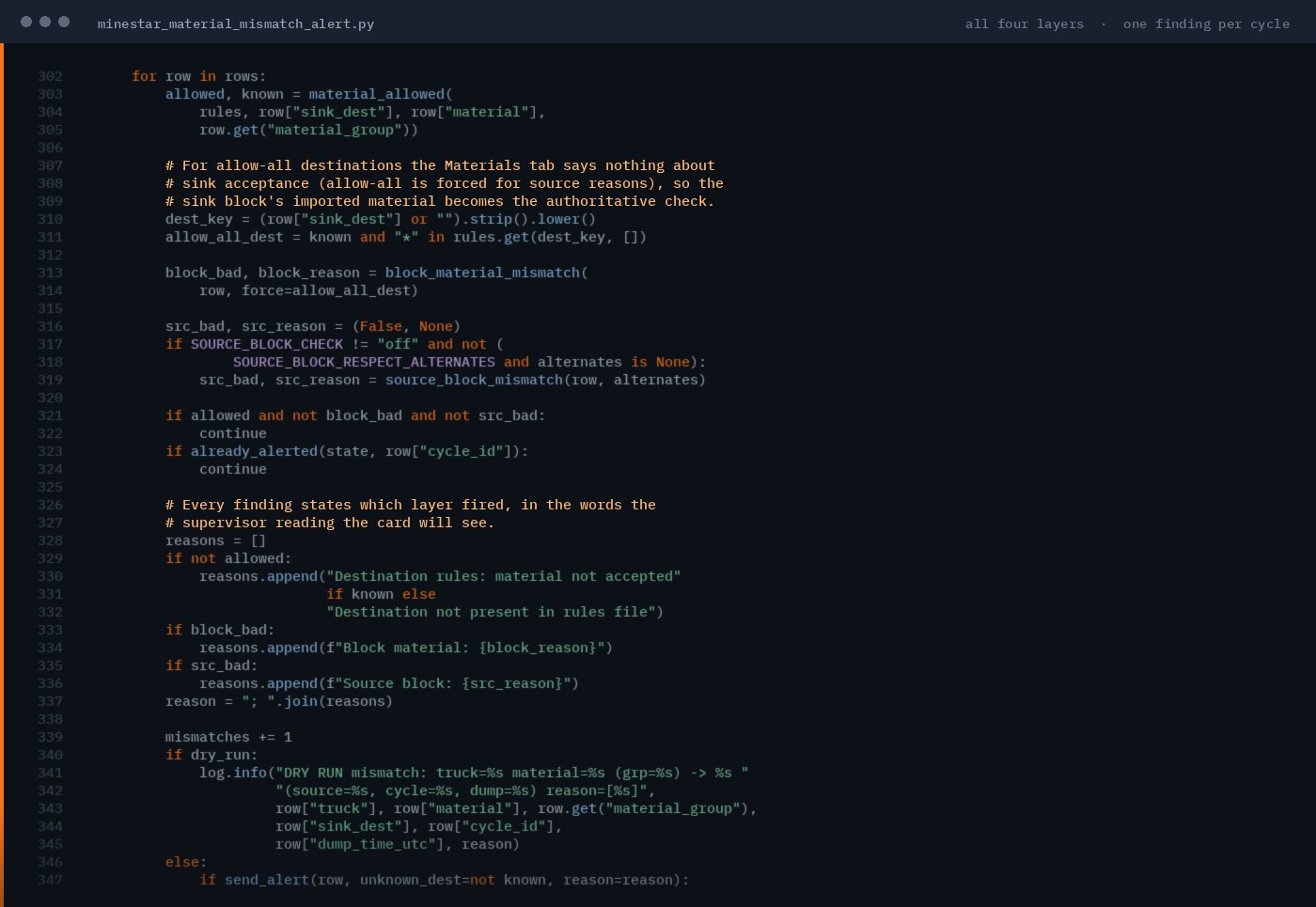
Layer 01
Destination Acceptance
Every load's material checked against what the sink destination is configured to
accept, read live from Minestar's own Destination Editor rather than a spreadsheet
kept somewhere else. Rules reload on every poll, so a change made in Minestar takes
effect immediately with nothing to redeploy.
Layer 02
Sink Block Material
The load compared against the block model material for the block actually dumped
on. This is what catches high grade landing on a low grade pad, and it becomes the
authoritative check on destinations flagged to accept all materials for source-side
reasons, where the destination configuration says nothing useful.
Layer 03
Source Block Material
The load compared against the block it came out of, which catches material
mis-tagged at the loading tool rather than at the dump. Deliberate contact digging is
respected: a load matching the block's configured alternates passes without noise.
Layer 04
Configuration Gaps
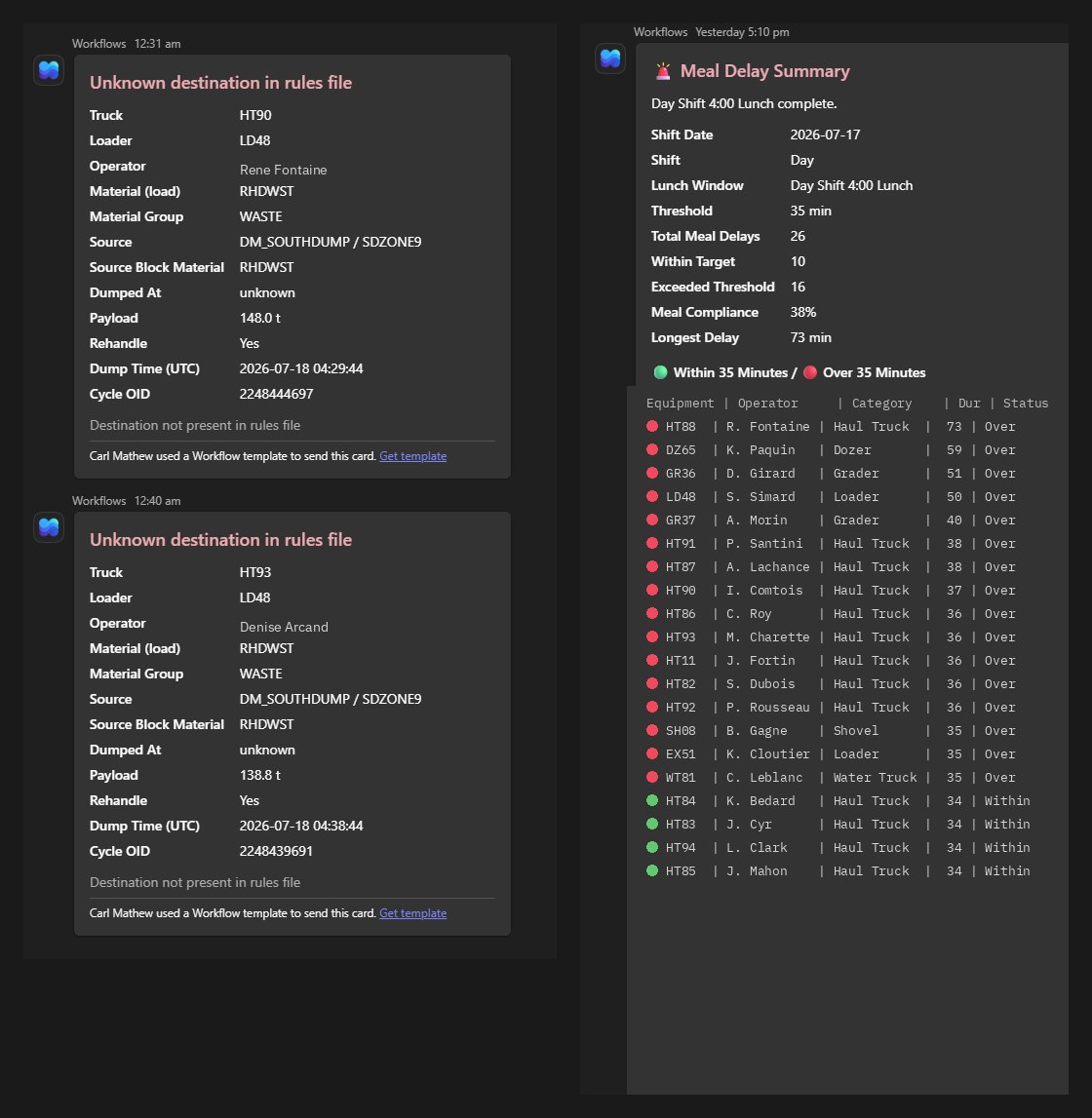
A sink destination with no acceptance rule at all is itself a finding, not
something to skip quietly. Switchable, so you can run silent while the rule set is
still being built and then start surfacing the gaps once it is not.
Override
Ore To Waste Is Never Noise
One rule overrides the rest. An ore-group block dug as waste-group material alerts
even when the alternates list technically permits it, because that loss is
unrecoverable and it is worth ten seconds of a supervisor's attention regardless of
what the configuration allows.
Signal
Once Per Cycle, Never Twice
Findings are keyed on the cycle so a load alerts once and never again, no matter
how often the service polls. The source block check fails closed: if its supporting
data cannot be read, that layer is skipped for the cycle rather than firing on
incomplete information. An alerting system nobody trusts gets muted in a week.
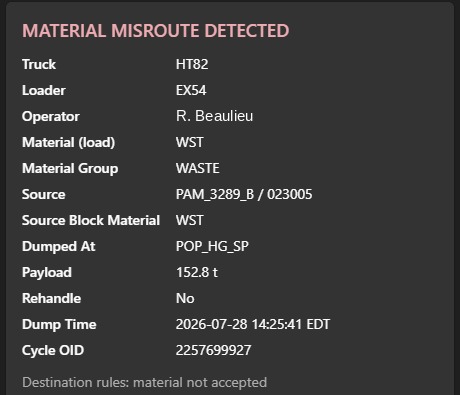
Reading that card: a 152.8 tonne load tagged as waste, from a block whose
model material is also waste, so nothing was mis-tagged at the loading tool. It went onto
a high grade stockpile. Layer 01 fired because that destination does not accept waste.
This is the dilution direction rather than the ore loss direction, and it costs you on
mill feed grade instead of in the waste dump. The same service catches both, and the card
names the block and the rule so the fix is obvious.
Screenshots from production systems. Personnel details have been altered and database schema identifiers are masked.
The alert
It lands where your people already are.
No new application, no per-seat licence, and no dashboard anyone has to remember to
open. A finding arrives as a card in a Microsoft Teams or Cisco Webex channel, and you
decide who is in that channel: dispatch, ore control, geology, the pit supervisor, the
superintendent, or all of them.
- Card contentsTruck, loading tool, operator, load material and group,
source destination and block, the block's model material, where it dumped, payload,
rehandle flag, and the dump time in site-local time.
- Reason lineEvery card states which layer fired and why, in plain
language, so the person reading it does not have to reconstruct the logic.
- LatencyEvery completed cycle is checked within sixty seconds of
appearing in your fleet system's reporting tables, continuously, all shift. The detection is
effectively immediate; the only delay is how quickly your fleet system publishes the
completed cycle, which is outside anyone's control and worth measuring at your site.
- ChannelsTeams or Webex incoming webhook. Webex is the simpler of the
two to stand up if your site is on it.
 BCM
BCM