Home / Platforms / Operations Advisor
Operations
Advisor
Threshold alerting needs somebody to know the number in advance. Most of what quietly costs
an operation money has no number: a haul route that got slower, a drill that dropped off
its own average, a face that stopped behaving like itself. This compares every unit of work
against its own history and writes up the departures, with the effect size, the sample it
is standing on, and how confident it is.
In practice
What an advisory looks like.
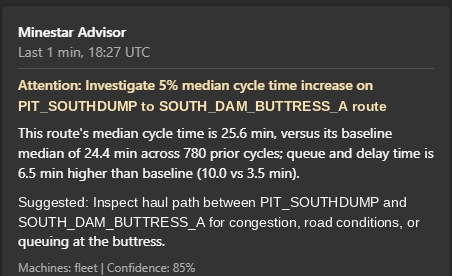
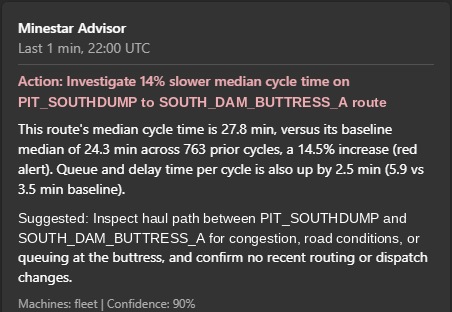
Two findings on the same haul route, at different points in the shift. Nobody configured a
limit for either. The route was measured against its own median across several hundred
prior cycles, and the wording, colour and confidence all move with the size of the
departure.
What to notice: a second signal has to agree before either card appears,
queue and delay time on the same route, which is what separates a genuinely slower haul
from ordinary variation. The sample count is on the face of the card so a supervisor can
weigh it in seconds. And the suggestion names what would make it a false alarm, a recent
routing or dispatch change. An advisory that tells you how it could be wrong is one people
will act on.
And that they are graded: five percent is amber, headed Attention, at 85
percent confidence. Fourteen and a half percent is red, headed Action, at 90 percent. Small drift gets
noted rather than escalated, so a channel stays triageable by scrolling instead of reading.
Screenshots from a production system. Destination identifiers have been altered; figures, baselines and sample counts are unchanged.
The baseline
Every deployment starts quiet. That is the point.
The advisor cannot report anything until it knows what your operation's normal is, and a
baseline is not something that can be shipped in a box. It has to be accumulated from your
own completed work. Several hundred cycles on a route before a comparison is worth making,
which a busy haul reaches in days and a road to a rarely used dump takes considerably
longer. Through that period the service is running and building history, and it says
nothing.
This is worth being direct about, because it is the honest test of any advisory system sold
into mining. Anything that starts making confident claims about your operation in its first
week is not comparing your operation to itself. It is comparing you to a model built
somewhere else, on somebody else's pit, somebody else's fleet, somebody else's haul
profile. The waiting is what makes the output about you.
Phase 01
Accumulate
The service reads completed work and builds a per-unit history. Nothing is published
and nobody is notified. If your warehouse already holds cycle history, this phase is
largely already done and the runway shortens accordingly.
Phase 02
Calibrate
Findings are generated but held back for review rather than posted to a channel. You
see what it would have said, and the sensitivity gets set against what your supervisors
actually found when they went and looked.
Phase 03
Publish
Advisories start arriving in the channel, graded. The baseline keeps moving from here,
so the reference is always recent history rather than a number frozen at commissioning.
Ongoing
The Baseline Never Stops Moving
Because it is recomputed rather than fixed, the comparison stays valid as the pit
deepens, routes change and the fleet turns over. A threshold set at commissioning is
wrong within a quarter and nobody notices.
Mechanism
Why the findings hold up in a meeting.
- Baseline learnedEach unit of work is compared against its own recent
history rather than a number somebody set once and nobody revisited.
- CorroboratedA deviation on one measure is a curiosity. A second measure
has to agree before it takes anyone's attention.
- Effect and sampleEvery advisory states the size of the change and how many
prior observations it rests on, so it can be weighed rather than trusted.
- Written as an actionThe headline is an instruction, not an observation, and
it names where to look and what to rule out first.
- Confidence statedSomething that never admits doubt gets either
over-trusted or ignored, and both are worse than being told how sure it is.
- Severity gradedWording, colour and confidence scale with the departure, so
a channel stays readable at a glance.
- Advisory, not autonomousIt recommends an inspection. It does not move
trucks, change destinations, or touch your fleet management system.
Scope
Haul routes are the first case, not the only one.
Why it pays
What this catches that nothing else does.
In development
A learned model, alongside rather than instead.
A machine learning model is being built to run next to the statistical layer described
above. Alongside is the important word, and it is a deliberate choice rather than a
transitional one.
Everything on this page so far is explainable. Each advisory states its own arithmetic: this
median, against that baseline, across this many cycles, corroborated by that second measure.
A supervisor who disagrees can disagree on the numbers, and be right sometimes. A model
cannot offer that, and an advisory nobody can audit gets filed as an opinion no matter how
good it is. So the transparent layer stays the part that talks to people.
What a model adds is the work statistics cannot do: patterns across many variables at once
rather than one measure against its own history, earlier warning from conditions that
precede a problem instead of accompanying it, and learning over time which findings actually
proved worth acting on when somebody went and looked. That last one matters most, because
precision is what decides whether a channel keeps getting read.
- StatusIn development. Not deployed, not priced, and not counted in any
estimate. Everything above this section is running now.
- RelationshipThe model informs and ranks. The explainable layer is what
writes the advisory, so every card stays auditable.
- PrerequisiteThe same history the baseline needs, plus a record of which
advisories were acted on, which is why the statistical layer has to run first.
Delivery
Scoped around the history you have.
- PrerequisiteCompleted work history. If it is already in a warehouse the
advisor can start calibrating almost immediately; if it has to be accumulated, that runway
is set out honestly before anything is signed.
- Typical build3 to 5 weeks to stand up the service and the first unit of
work, then a calibration period whose length depends on your data rather than on us.
- Reads fromYour warehouse, or your fleet management system directly,
read-only. Nothing is written back and no dispatch decision is automated.
- Runs onYour own infrastructure, including the language model that
writes the advisory. This is not a cloud API with your production data posted to it: the
model is served locally on the same server, so nothing about your operation leaves the
property and there is no per-call metering on the analysis.
- DeliveryTeams or Webex, using the same graded channel as the rest of the
alerting layer.
- Pairs withOperational alerting for the threshold cases, and the SQL
warehouse for the history this depends on.
 BCM
BCM